Efficient Bracket Placement with Ormco: Clinical Tips from AMS Speakers
Bracket placement accuracy determines whether a treatment plan finishes on schedule or drags into extra months of adjustments. A 0.5mm vertical error on a single bracket can mean the difference between finishing in 14 months and needing 18. Ormco's bracket systems — particularly the Damon Ultima and Digital Bonding workflow — address placement precision at both the hardware and software level. This article compiles clinical techniques taught by AMS (Annual Master Series) faculty alongside the engineering behind Ormco's current bonding solutions.
Why Bracket Position Errors Compound Over Treatment
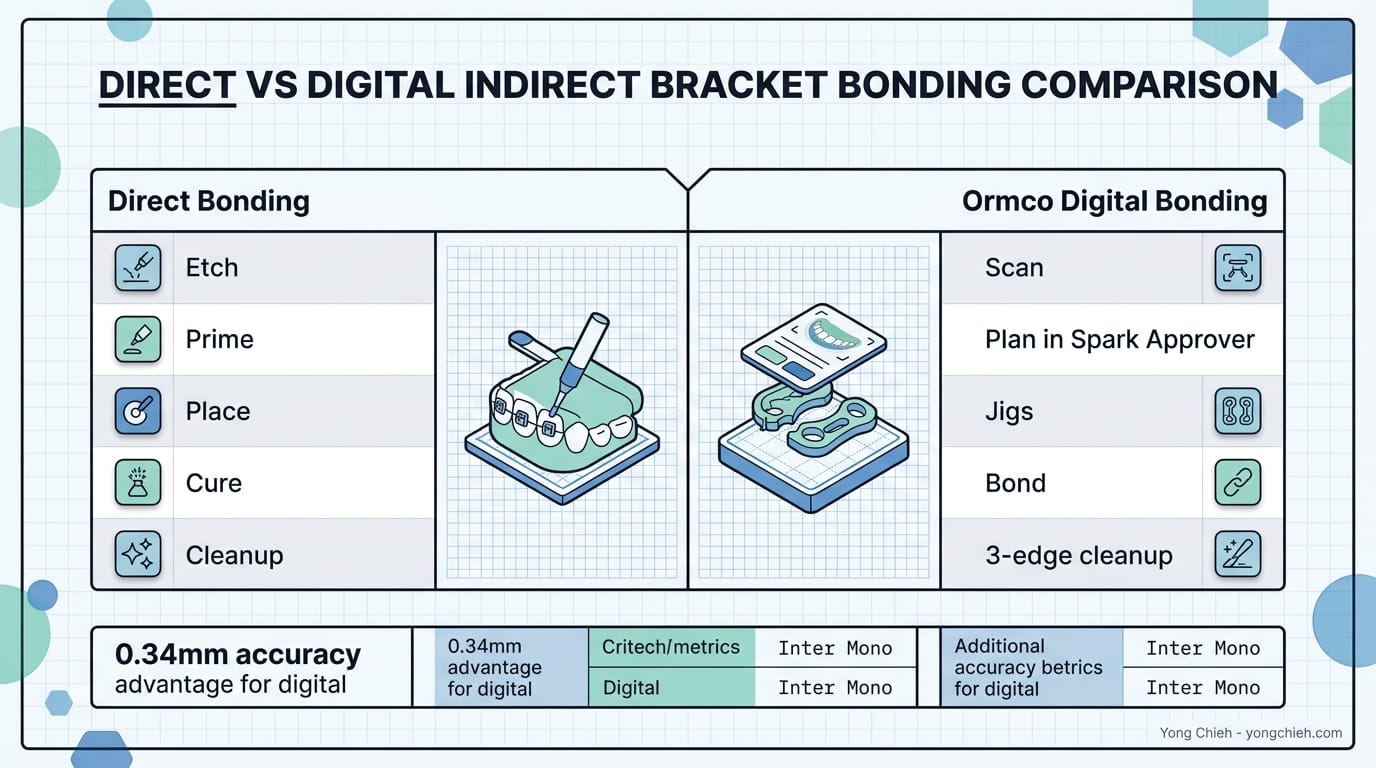
Orthodontic brackets control tooth movement in three dimensions: vertical height governs intrusion/extrusion, mesiodistal position controls rotation, and base-to-tooth adaptation determines torque expression. A 2024 randomized clinical trial published in the International Journal of Dentistry compared direct and digital indirect bonding accuracy. Digital indirect bonding showed a mean translational advantage of 0.34mm and an angular advantage of 4.80° — statistically significant improvements that translate directly into fewer mid-treatment rebonds.
The three placement errors that cause the most downstream problems:
| Error Type | Clinical Consequence | How It Happens |
|---|---|---|
| Mesiodistal offset | Unwanted rotation | Failing to confirm the tooth's long axis from the facial AND occlusal view |
| Wing-to-axis misalignment | Crown tipping | Bracket wings not parallel to the vertical long axis |
| Base adaptation gap | Torque/rotation distortion | Excess adhesive trapped under the bracket base |
Each of these errors adds unplanned appointments. A single rebond takes 10-15 minutes of chair time plus the cost of materials and patient inconvenience. Across a busy practice seeing 30-40 orthodontic patients per day, systematic placement improvement compounds into measurable efficiency gains.
Damon Ultima: Engineering That Supports Placement Precision
The Damon Ultima System represents the eighth generation of Ormco's self-ligating bracket platform. Self-ligating brackets are orthodontic appliances that use a built-in door mechanism instead of elastic ligatures to secure the archwire, reducing friction and enabling lighter treatment forces throughout the course of care.
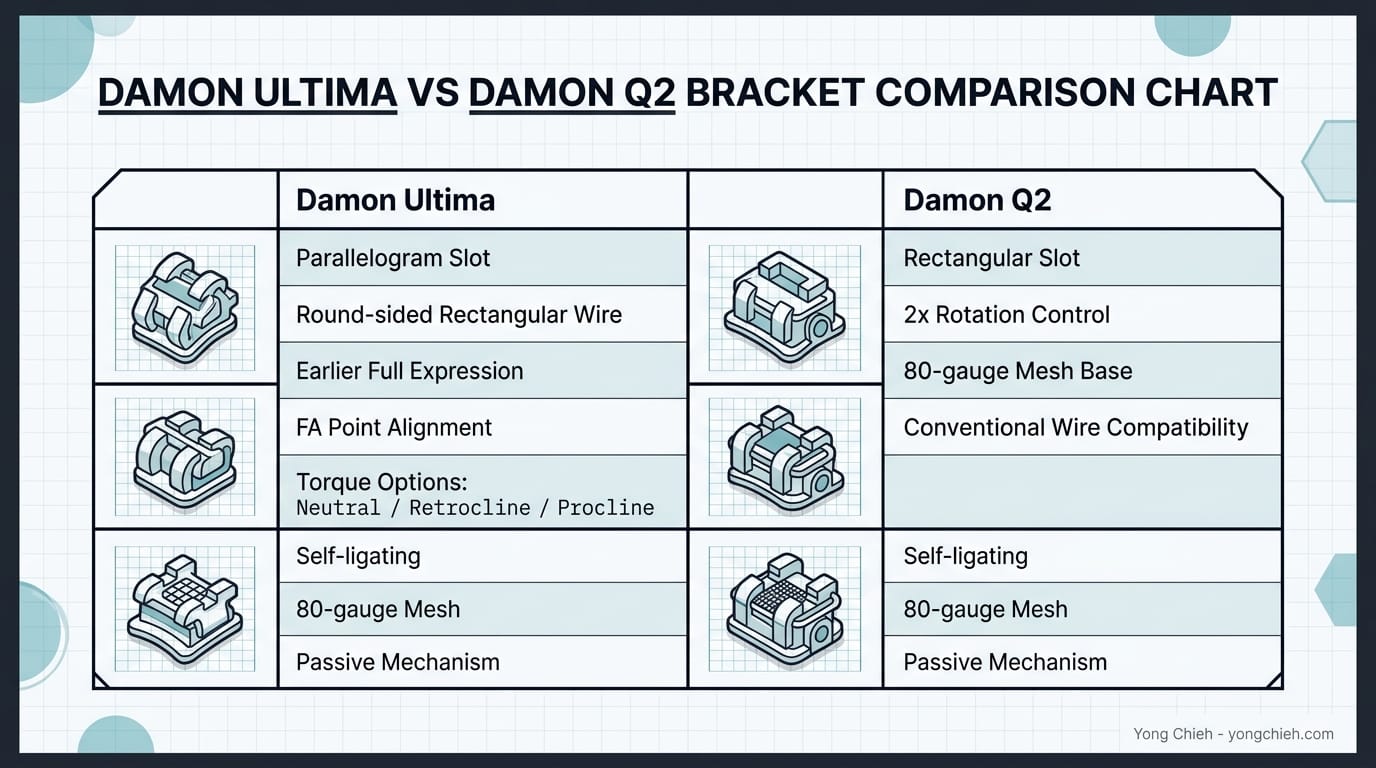
What makes Damon Ultima distinct from its predecessors is the parallelogram-shaped slot paired with a round-sided rectangular wire. This geometry virtually eliminates the "play" — the gap between wire and slot — that conventional rectangular-wire-in-rectangular-slot systems tolerate. The clinical consequence: rotational control begins with the first round-sided rectangular wire, and full prescription expression (including torque) arrives with the second wire.
Clinical validation from a multi-site study involving 8 centers, 10 orthodontists, and 133 patients confirmed earlier rotational control compared to previous Damon generations. The bracket base uses an 80-gauge mesh with a rhomboid pad design and enhanced scribe line, giving clinicians a clear visual landmark during placement. Center-point slot alignment at the facial axis (FA) point provides an anatomical reference that reduces guesswork.
Available torque configurations — neutral, retrocline, and procline — allow practitioners to select prescriptions matching their case planning without relying on wire bends to compensate for bracket position.
Ormco Digital Bonding: The Indirect Workflow That Uses One Software Platform
For practitioners who want maximum placement accuracy without manual transfer tray fabrication, Ormco Digital Bonding digitizes the entire indirect bonding process. The system runs through three phases.
Phase 1 — Submit. The clinician sends a digital impression through a unified portal. The same Spark Approver software handles both Spark clear aligner cases and bracket bonding cases, so practices already using Spark do not need to learn a separate platform.
Phase 2 — Approve. The software calculates optimal bracket positioning for each tooth based on the selected prescription, then generates custom Jigs — printed transfer devices with individual bracket receivers. The orthodontist reviews and adjusts positions digitally before manufacturing begins.
Phase 3 — Bond. Each Jig "cap" wraps the tooth buccally and lingually, providing stable three-dimensional positioning during bonding. After light curing, cleanup requires attention to only three edges of the adhesive pad rather than the full circumference. Currently supported brackets include Damon Ultima, Damon Q2, and Symetri Clear.
The efficiency gain is most pronounced in multi-bracket cases: a full-arch bonding using digital jigs consistently takes less chair time than placing 14 brackets individually with direct bonding, and the positional accuracy is higher.
Clinical Bonding Techniques from AMS Faculty
The Annual Master Series (AMS) is Asia's leading dental continuing education platform, hosting international faculty across orthodontics, periodontology, and implantology. AMS courses combine evidence-based lectures with hands-on clinical workshops. The following bracket placement techniques are frequently emphasized in AMS orthodontic sessions.
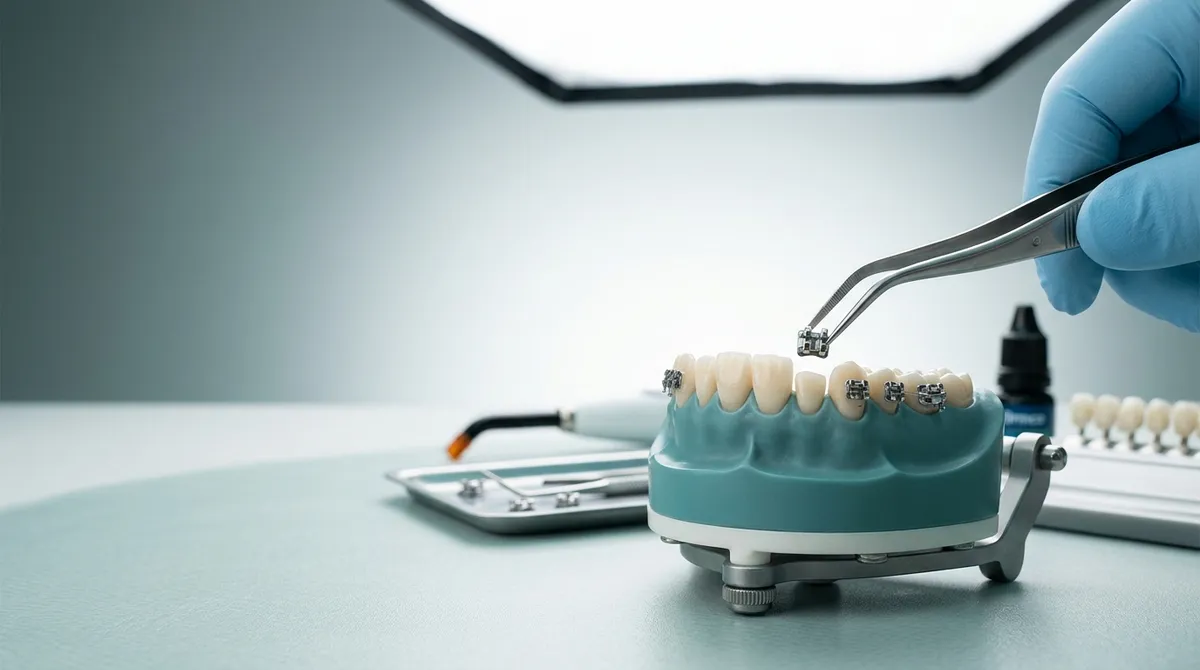
Verify the long axis before touching adhesive. Faculty consistently identify this as the most commonly skipped step. The tooth's vertical long axis must be confirmed from both the facial surface and the occlusal/incisal aspect (using a mouth mirror). Misjudging the long axis is the root cause of most rotational and tipping errors.
Use the wire guidance technique for vertical calibration. Before curing any bracket, thread a heavy-gauge archwire through the bracket slot and adjacent already-bonded brackets or bands. The wire serves as a reference plane for vertical and angular alignment, while the clinician manually adjusts mesiodistal position. This technique catches placement errors before the adhesive sets — when correction costs nothing.
Invest in consistent height gauge use. An anterior height gauge is standard equipment, not optional. AMS instructors recommend creating a bracket position chart for each arch, with target heights documented per tooth. This allows trained assistants to verify placements, which is particularly valuable during full-arch same-day bonding sessions.
Manage adhesive deliberately. The paste-consistency adhesive must be spatulated fully into the bracket base mesh — partial coverage leads to bond failures. After pressing the bracket onto enamel, all flash must be removed with an explorer or scaler. Residual adhesive beneath the base is invisible clinically but creates torque and rotational errors that only become apparent during wire progression.
Match bonding strategy to case complexity. AMS faculty do not advocate digital indirect bonding for every case. Straightforward cases with minimal rotations respond well to skilled direct bonding. The return on investment for digital bonding increases with case complexity: severe crowding, multiple rotated teeth, or situations requiring precise torque differentiation across adjacent teeth.
Implementing a Precision Bonding Protocol in Your Practice
Transitioning from standard to precision bonding works best as a phased approach rather than an all-at-once overhaul.
Phase 1 — Standardize direct bonding. Build a bracket position reference table for your most common case types. Invest in quality height gauges. Photograph every bonding (facial and occlusal views) to create a retrospective quality database. Track rebond rates per arch position.
Phase 2 — Pilot Digital Bonding. Select 10-15 moderate-complexity cases for your initial Digital Bonding experience. Work with Yong Chieh's technical team for Spark Approver software training. Compare treatment timelines and adjustment visits between digital-bonded and direct-bonded cases in your practice.
Phase 3 — Refine and educate. Attend AMS orthodontic courses to exchange techniques with international faculty. Track precision metrics (rebond rate, unplanned wire bends, finishing appointment count) and feed results back into your standard operating procedure.
About Yong Chieh
Yong Chieh Enterprise has served Taiwan's dental community since 1993 as the exclusive authorized distributor for Ormco, Kerr, HuFriedyGroup, EdgeEndo, and other international brands. With over 10,000 products, three regional offices across Taiwan, and a deep commitment to clinical education through the Annual Master Series (AMS), Yong Chieh is more than a supplier — we are a lifelong partner in your professional growth.
As Ormco's exclusive Taiwan distributor, Yong Chieh provides factory-trained technical support for the complete Damon product line and Digital Bonding workflow, including on-site training for practices adopting digital indirect bonding for the first time.
Interested in integrating the Damon Ultima system or Ormco Digital Bonding into your practice? Contact Yong Chieh — Taiwan's authorized Ormco distributor since 1993. We provide product consultation, hands-on training, and ongoing technical support.
Want to advance your clinical skills with world-class instruction? Explore upcoming AMS courses and workshops or contact us to learn about continuing education programs in orthodontics.
Frequently Asked Questions
Q: What is the difference between Damon Ultima and Damon Q2 for bracket placement?
Damon Ultima uses a parallelogram-shaped slot with round-sided rectangular wire for earlier full-expression control. Damon Q2 features a conventional rectangular slot with 2x rotation control. Both use 80-gauge mesh bases. Ultima targets maximum prescription expression; Q2 balances precision with familiarity for clinicians transitioning from Damon Q.
Q: How much chair time does Ormco Digital Bonding save compared to direct bonding?
Full-arch digital indirect bonding typically saves 15-25 minutes of active chair time compared to placing brackets individually. The efficiency gain comes from simultaneous positioning of multiple brackets via custom jigs rather than one-by-one placement. Setup and planning time occurs outside the patient appointment.
Q: Where can I find an authorized Ormco distributor in Taiwan?
Yong Chieh Enterprise has been Ormco's exclusive authorized distributor in Taiwan since 1993. As an authorized partner, Yong Chieh provides genuine products with full manufacturer warranty, factory-trained technical support, and access to continuing education programs including the AMS Master Series.
Q: What orthodontic continuing education does AMS offer?
AMS (Annual Master Series) offers hands-on workshops, lecture series, and case discussion sessions in orthodontics, periodontology, and implantology. Programs feature international faculty and combine online pre-course preparation with in-person clinical training designed for Asian dental professionals.
Q: Is indirect bonding more accurate than direct bonding for orthodontic brackets?
A 2024 split-mouth randomized trial found digital indirect bonding achieved 0.34mm better translational accuracy and 4.80° better angular accuracy than direct bonding. However, indirect bonding showed higher immediate bond failure rates (3.9% vs 0%). The optimal method depends on case complexity, operator experience, and practice workflow.
Q: Can I use Ormco Digital Bonding with bracket systems other than Damon?
Currently, Ormco Digital Bonding supports Damon Ultima, Damon Q2, and Symetri Clear brackets. The system is designed specifically around Ormco's bracket geometries and prescription data. Third-party brackets are not compatible with the Spark Approver software's positioning algorithms.
Q: What is the learning curve for switching to digital indirect bonding?
Most orthodontists report comfort with the digital workflow after 5-10 cases. The primary adjustment is shifting from chair-side placement decisions to pre-appointment digital planning. Clinicians already using Spark Approver for clear aligner cases adapt faster since the software interface is shared.
References
- Al-Ubaydi, R. et al. (2024). Do the Various Indirect Bonding Techniques Provide the Same Accuracy? Randomized Clinical Trial. International Journal of Dentistry.
- Ormco Damon Ultima System — Official Product Specifications
- Ormco Digital Bonding — Powered by Spark Technology
- AMS Dental Mastery — Inside AMS Programs
- American Association of Orthodontists — Continuing Education Resources